
Condition 8503 can prevent an onshore partner visa application, but it does not automatically mean a couple must spend the entire offshore partner visa process apart. In the video above, Martin explains a different sequence that may allow an eligible applicant to apply for a Bridging Visa A after arriving in Australia.
The important distinction is between lodging an onshore Subclass 820/801 application after arrival and entering Australia after a properly planned offshore Subclass 309/100 application. The visas, timing and conditions must be assessed together.
The key points for couples
- The government has announced wider use of No Further Stay conditions on visitor visas. Detailed implementation still matters.
- An 8503 waiver and a bridging visa application are different processes. Neither is automatic.
- In the sequence discussed in the video, the visitor visa is granted before the offshore partner or prospective marriage application is lodged.
- Work rights, Medicare, travel and the location required for the final visa grant are separate questions.
What was announced on 17 September 2026?
The Minister for Home Affairs announced a move to attach a No Further Stay condition to all visitor visas as part of a broader migration package. The stated purpose is to keep visitor visas focused on genuine temporary visits. See the Minister’s official announcement.
That is a significant development from the proposal discussed in our August visitor-to-partner visa update. However, the release alone does not settle when each change applies, how existing grants are treated or the detailed position for Subclass 600, ETA 601 and eVisitor 651 holders.
Martin’s video suggests the announcement could give decision-makers more confidence when assessing genuine visits by partners of Australians. That is his interpretation of the announcement, not a promise that a visitor visa will be granted or that assessment standards have been relaxed.
What does condition 8503 mean for a partner visa?
Condition 8503 is commonly called No Further Stay. It restricts further substantive visa options while a person remains in Australia after entering on the conditioned visa. An onshore partner visa application will generally require the condition to be waived first. A bridging visa is a different category of visa; that distinction is central to the sequence Martin discusses.
Start with your visa grant notice and VEVO conditions. Check the permitted stay for each entry, not just the last date on which the visa allows travel. Other conditions, including 8531, can create separate departure obligations and need their own assessment.
Can you get an 8503 waiver?
A waiver may be available where compelling and compassionate circumstances developed after the visa was granted, were beyond the person’s control and caused a major change in their circumstances. Wanting to lodge a partner visa is not, by itself, a reliable waiver strategy.
A waiver request does not extend the visitor visa or itself provide a bridging visa. Home Affairs must assess the request, and a waiver is not guaranteed. Read the No Further Stay waiver guidance and Form 1447.
What about ETA and eVisitor holders?
The video expressly leaves this question open. Do not treat Martin’s view about the existing Subclass 600 framework as confirmation that ETA or eVisitor holders are exempt from future changes. Equally, an announcement is not a substitute for checking the conditions of an existing grant and the rules that apply when an application is lodged.
The offshore partner visa sequence explained
At 5:38 in the video, Martin sets out the alternative he previously called the “silver pathway”. It concerns a visitor visa held before a valid offshore application—not simply applying for a visitor visa at any point during a 309 wait.
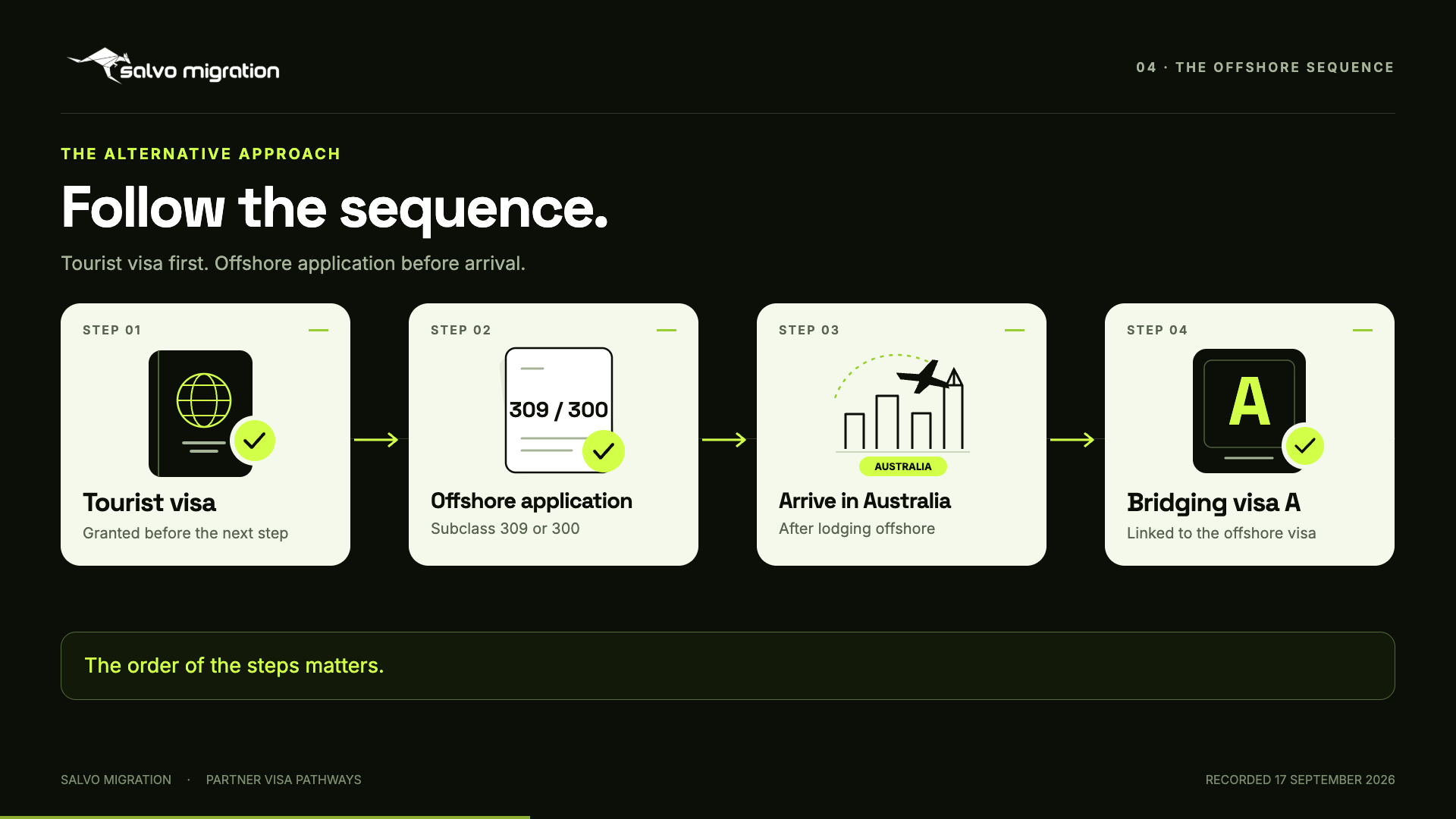
- Visitor visa granted firstThe applicant holds the relevant substantive visa before the offshore application is made. A pending visitor application is not the same as a visa grant.
- Lodge the appropriate application while outside AustraliaDepending on eligibility, this may be an online Subclass 309/100 partner application or a Subclass 300 Prospective Marriage application. These are different pathways with different requirements.
- Enter Australia lawfully on the visitor visaComply with the visa’s entry and stay conditions. Explain your circumstances honestly in visa applications and at the border.
- Apply separately for the relevant bridging visaOnce in Australia, the applicant may be able to seek a Bridging Visa A associated with the pending offshore application. Eligibility and the supporting application must be checked; lodging offshore does not automatically issue a BVA.
Why does the order matter? One of the BVA criteria concerns holding a substantive visa when the underlying application was made. There are also requirements about the application’s validity, where it is legally made and whether the visa is of a kind that can be granted in Australia. Those questions require care with an online application made by someone physically overseas.
Martin explains that Salvo has obtained bridging visas in the sequence discussed. His account of those matters illustrates an available strategy to investigate; it does not establish eligibility for every couple. Home Affairs sets out the separate bridging visa application process.
Work rights, study and Medicare are separate checks
A BVA linked to the offshore scenario in the video should not be treated as carrying the same permissions as a BVA associated with an onshore 820 application. Read the grant notice, when the bridging visa comes into effect and its conditions.
Working in Australia
Do not start work unless your visa in effect permits it. A further BVA application based on a compelling need to work may be available where the criteria are met.
Studying in Australia
Check the conditions of the visa currently in effect. A visitor visa’s study limits do not disappear just because a future bridging visa has been granted.
Medicare: 309/100
Services Australia includes combined 309/100 applicants in its permanent-residency applicant rules. Living in Australia and the additional eligibility requirements must be satisfied.
Medicare: Subclass 300
A prospective marriage application alone is not the same as applying for permanent residency. Check whether another basis, such as a reciprocal healthcare agreement, applies.
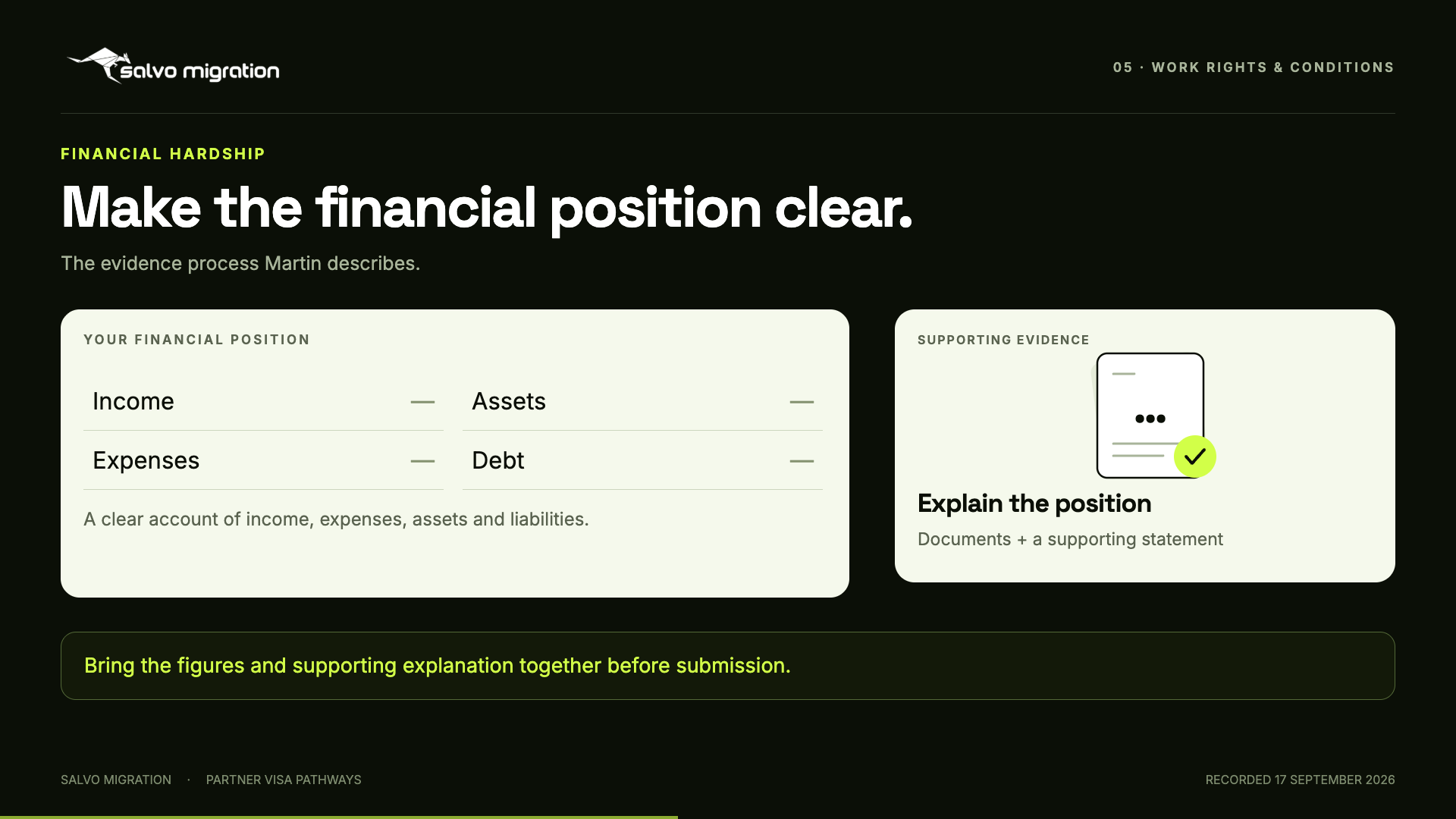
In the video, Martin describes presenting the couple’s financial position clearly when seeking work rights: income, reasonable expenses, accessible assets, debt and a supporting explanation. Evidence needs to support the claimed hardship. Neither approval nor a fixed processing time should be assumed.
For healthcare, use the Services Australia Medicare enrolment rules. A bridging visa grant and Medicare enrolment are separate decisions.
Can you travel while the offshore partner visa is pending?
A Bridging Visa A does not provide a right to leave and re-enter Australia. An eligible BVA or BVB holder who needs to travel may be able to apply for a Bridging Visa B with a specified travel period. Obtain the correct grant before leaving and check the return deadline.
Martin discusses examples of longer BVB travel periods. Treat those as examples, not a standard three-year entitlement. The period and conditions on your own grant notice control your travel.
Do offshore partner visas have lower processing priority?
Home Affairs says Direction 117 gives higher priority to relevant Family visa applications made while the primary applicant was in Australia and for visas grantable in Australia. Applications made while the applicant was overseas, or requiring an offshore grant, receive lower priority. This is separate from the September visitor visa announcement. See the official Family visa processing priorities.
Coming to Australia after an offshore lodgement does not turn it into an onshore 820 application. However, a priority category is not a promised waiting time. The policy does not tell each couple how many extra months their application will take.
The video also discusses historical differences between assessing locations. Our partner visa processing time estimator provides planning context from its stated sources and methodology. Historical data cannot fully predict the effect of a new policy. For the broader explanation, read our partner visa processing times guide.
What should you and your partner do next?
- Gather the grant notice and VEVO record. Identify every condition, the permitted stay and the entry deadline.
- Put the dates in order. Record the visitor grant, any 309/100 or 300 lodgement, travel and current visa expiry.
- Check eligibility before paying or travelling. Relationship, sponsorship and application validity still matter, even where a bridging strategy is available.
- Plan the practical questions separately. Budget for any period without work rights, confirm healthcare, and check travel and final-grant requirements.
- Get advice while you still have time. Do not rely on a pending waiver or bridging request as permission to overstay.
A genuine visitor must satisfy the relevant temporary-stay requirements. A possible later bridging pathway is not permission to hide plans or give misleading answers. If you want Salvo to assess and manage the sequence, provide the documents and dates so our team can advise on your actual position.
Frequently asked questions
Does 8503 stop every partner visa option?
No. It generally restricts an onshore partner application unless waived. An offshore application and a separately assessed bridging strategy may still be relevant. The whole visa history and all conditions must be checked.
Does applying for a 309 visa automatically give me a bridging visa?
No. An offshore lodgement does not automatically provide a BVA. The video discusses a separate application after arrival, where the visitor visa was already held when the offshore application was lodged and all relevant criteria are met.
Will all visitor visas have 8503 from 17 September 2026?
The Minister announced No Further Stay conditions for all visitor visas, but the release does not set out the full commencement and transitional arrangements. Check current implementation guidance and the conditions of your own grant rather than assuming a universal start date.
Can I work as soon as the bridging visa is granted?
Only if the visa currently in effect allows it. A BVA may come into effect later and may restrict work. Work rights may require a further application supported by evidence of a compelling need to work.
Can I stay in Australia until the 309 or 300 decision?
That depends on your lawful visa status, bridging eligibility and all conditions. Even where a bridging visa permits a stay while processing continues, 8503 may mean departure is necessary for the final substantive visa grant.
Map the right sequence for your circumstances.
If you are considering legal representation, tell us where you and your partner are, the visas already held and any applications lodged. Our team can assess the pathway, timing and risks.
Discuss your partner visa options →Preparing your evidence yourself? Start with the free partner visa checklist.Published by Salvo Migration, a Queensland lawyer-led legal practice. Based on Martin Salvo’s video recorded 17 September 2026; this adapted article is published by the practice. General information only, not individual legal advice. Visa rules, policy and implementation can change. Eligibility, grants, work rights and processing times are not guaranteed. Meet our legal team.