Find your likely pathway
Answer high-level questions and see which visa family may be relevant.
Get clear on the pathways, eligibility rules, relationship evidence, costs and process—then turn what you learn into a practical checklist.
A complex process, made manageable.
General information in plain English.
Partner visa information is often scattered across subclass pages. This guide joins the essentials into one navigable experience while keeping the legal boundary clear.
Answer high-level questions and see which visa family may be relevant.
See how the four relationship evidence pillars work together.
Explore the stages, common risks and practical preparation steps.
These answers tailor the explanation. They stay on this device and are not sent to Salvo Migration.
Important: educational guidance only—not an eligibility assessment or legal advice.
The applicant, sponsor and relationship each need to meet relevant requirements. Read the fuller Australian partner visa eligibility and requirements guide before treating this overview as complete.
Usually a spouse, de facto partner or—under subclass 300—a prospective spouse.
Usually an Australian citizen, permanent resident or eligible New Zealand citizen.
The relationship must be genuine and continuing, with mutual commitment to a shared life.
Identity, health, character, location and visa status can affect the process.
De facto applicants generally face a 12-month relationship requirement unless an exception applies, but married applicants are assessed under spouse criteria.
Decision-makers consider the relationship as a whole: mutual commitment, exclusivity, continuity and whether the couple live together or are not permanently separated.
Time apart does not automatically prevent a visa, but explain why it occurred, how the relationship continued and how you remained committed.
The applicant's location and whether the couple is married, de facto or intends to marry often shape the starting point.
A combined application for temporary subclass 820 and permanent subclass 801, usually made while the applicant is in Australia.
Current visa, conditions, lawful status and location at key stages may matter. Travel and bridging visa questions need individual checking.
A combined application for provisional subclass 309 and permanent subclass 100, usually made while the applicant is outside Australia.
Travel plans, current visas in other countries and the applicant's location should be planned carefully.
A temporary visa for a person outside Australia who intends to come to Australia and marry their prospective spouse within the visa period.
The couple generally must have met face to face as adults and plan the later Partner visa before subclass 300 expires.
Permanent-stage eligibility is generally considered two years after the original combined application, although exceptions can apply.
Strong applications usually organise evidence into four connected areas and explain what each document demonstrates.
Show how finances operate in real life, not merely that a joint account exists.
Dates and history should align across forms, statements and documents.
Different periods show continuity better than a last-minute bundle.
Explain circumstances that shape how your relationship looks.
The exact sequence varies, but this is the shape of a typical combined Partner visa journey.
Confirm subclass, sponsor position, location, current visa conditions and complicating history.
Create a chronology, identify gaps and gather identity, relationship, sponsor, health and character material.
Complete the application, pay the charge and submit the sponsorship with accurate, consistent information.
Upload evidence methodically and complete health, police and information requirements when appropriate.
Monitor correspondence, meet deadlines and notify Home Affairs of relevant changes.
Continue preserving evidence for stage two and follow Home Affairs instructions.
Home Affairs currently states applicants can attach up to 100 documents for each person. Clear labelling and coherent evidence are more useful than duplication.
Government charges and processing data change. Recheck official information immediately before acting.
For most 820/801 applicants, as listed from 1 July 2026. Concessions and different charges can apply.
Charges can be indexed and payment surcharges may apply.
Police, health, translation, certification and travel costs can add up.
Legal assistance is separate. Ask what is included and whether fees are fixed.
Published figures describe recently decided applications—not a promise.
Completeness, identity, health and character checks, information requests, complexity, changed circumstances and government workloads.
Some circumstances can change strategy, validity or eligibility. Obtain individual advice if a risk point may apply.
Section 48, review rights or another restriction may affect onshore options.
Onshore pathways may involve additional criteria and careful timing.
A current visa condition may prevent an onshore application unless waived.
Past sponsorships, offences or other factors can affect sponsorship.
Medical history, criminal records and disclosure need careful handling.
Special provisions may be relevant. Safety comes first.
You now understand the main pathways, evidence pillars, application stages and risk points. The next step is to organise your own evidence.
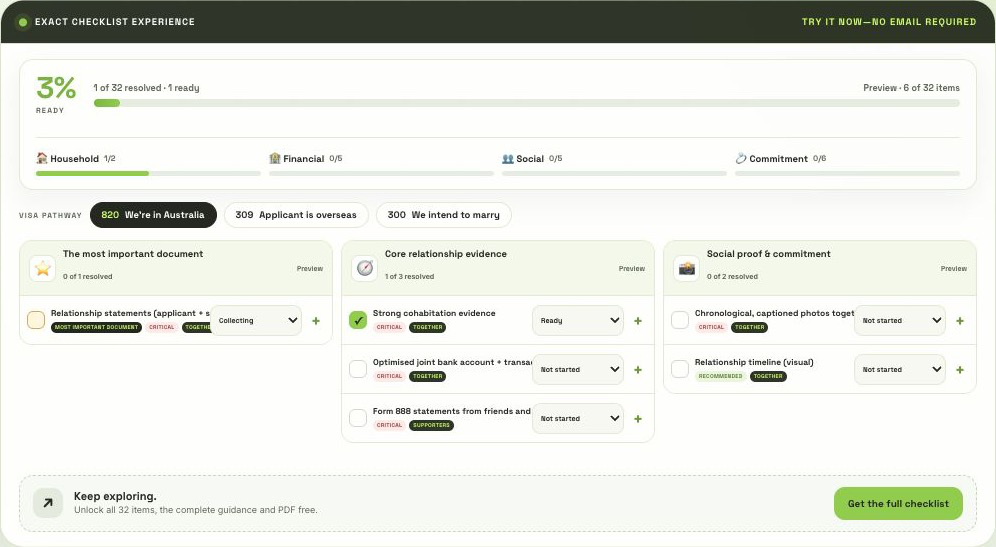
Clear starting answers, with official sources where information can change.
The likely pathway depends on location, relationship status, sponsor eligibility and visa history. Common pathways are 820/801, 309/100 and subclass 300.
Not in every case. De facto applicants generally face a 12-month requirement unless an exception applies. Married applicants are assessed under spouse criteria.
Evidence is commonly organised around financial, household, social and commitment aspects. Quality, consistency, context and time coverage matter.
Charges change. Home Affairs listed 820/801 from AUD 11,710 for most applicants from 1 July 2026. Check the official estimator.
Processing varies. Home Affairs publishes a guide based on recently decided cases; it is not a promise for an individual application.
Last reviewed 21 July 2026. Government policy, charges and processing information can change.
Legal information boundary: This guide provides general information only and is not legal advice. It does not assess whether you can make a valid application, meet visa criteria or obtain a particular outcome.